
Path: Workspace Homepage >> Navigation Panel >> Reporting
| What are Reports? |
| Reports are visual representations of workspace and community data — both system-generated and custom-built — that can be incorporated into dashboards to track selected metrics. |
The Reports page provides a comprehensive list of both system-generated reports and custom reports, giving Workspace Administrators and Community Administrators a way to visually represent workspace and community data for easier understanding and analysis. Reports can be incorporated into dashboards to display data on the parameters administrators wish to monitor.
Role Permissions
- Workspace Administrator, Community Administrator & Community Moderator: Creates and manages Reports at the workspace level, including building custom reports from the Basic Report, Historical Snapshot Report, and Journey Report types; viewing the List of Reports; performing report actions such as Add to Dashboard, Rename, Clone to My Reports, Access & Permission, and Delete; and applying filters.
List of Reports
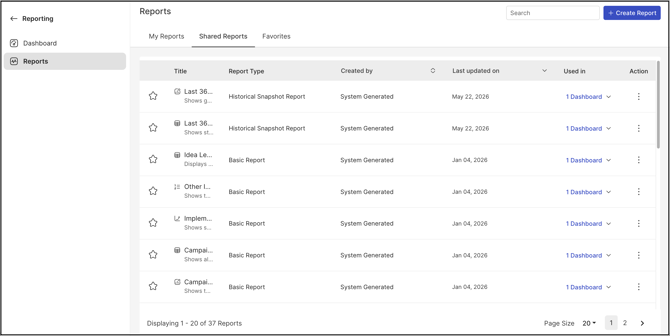
The List of Reports presents all available reports along with their titles, the creator's name, the date of last update, the number of dashboards in which each report is used, and available actions. The "Used In" column indicates how many dashboards incorporate a given report; selecting the count reveals a dropdown menu listing the names of those dashboards. Selecting a dashboard name from that list opens that dashboard for further review.
Actions
The Actions header provides a dropdown menu containing various actions administrators can perform on a report. These options closely resemble those available on the dashboard, providing a familiar experience. Available options vary between system-generated and custom reports.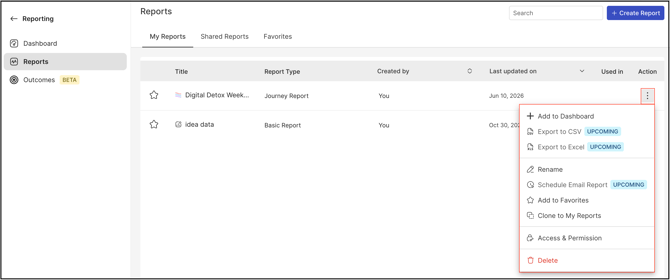
- Add to Dashboard
- Export data to CSV (Upcoming)
- Export data to Excel (Upcoming)
- Rename (Not available for system-generated reports)
- Schedule Email report (Upcoming)
- Add to favourites
- Clone to My Reports (Not available for system-generated reports)
- Access & Permission (Not available for system-generated reports)
- Delete (Not available for system-generated reports)
Create Report
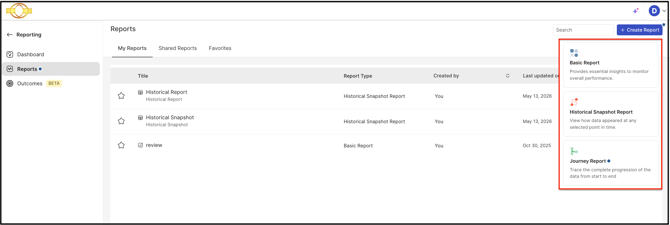
To create a report that meets specific needs, the administrator selects the Create Report option. IdeaScale offers three types of reports:
- Basic Report — see below.
- Historical Snapshot Report — Help Article for Historical Snapshot Report
- Journey Report — Help Article for Journey Report
After selecting a report type, the report is customized by specifying the data category, setting the desired time frame, and applying any relevant filters to achieve the desired results.
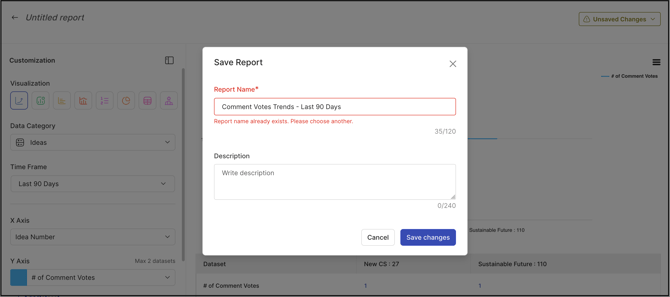
Note: The report name must be unique and cannot duplicate the name of an existing report. Attempting to use an existing report name displays an error message.
Basic Report
The Basic Report allows selection and customization of a report from various data categories, along with selecting the data to display on the X and Y axis.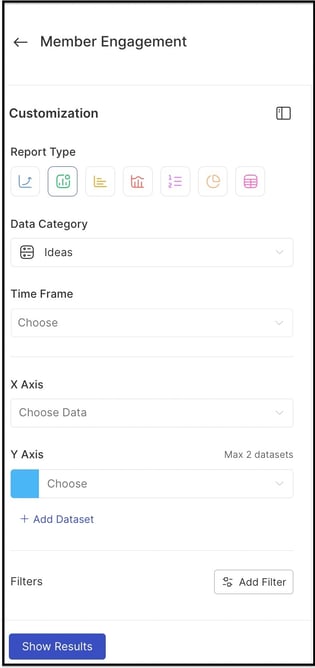
The customizable elements of a Basic Report are as follows:
- Report Type: Selectable from line, bar, horizontal bar, dual axis, metric card, donut, and table report.
- Data Category: Limited to two categories — Idea and Member.
- Time Frame: A custom time frame required to track data throughout the reporting tool. The following options are available when selecting a time frame:
- Last 7 days
- Last 30 days
- Last 90 days
- Last 180 days
- Last 365 days
- All Time (only available for Metric Card)
- Custom Range: Allows selection of a time frame from a calendar.
- X Axis: The available datasets vary based on the selected Data Category; the Frequency option remains accessible regardless of the category chosen.
- When Idea is selected as the Data Category:
- Time Properties: Daily, Weekly, Monthly, Quarterly, Yearly
- Idea Properties: Idea Number, Idea Title, Idea Submission Date, Idea Submitter, Idea Owner, Stage, Campaign Group, Campaign, Community, Workspace Group, Community Group, Idea Custom Fields, Workspace Member Profile Questions, Member Profile Questions
- When Member is selected as the Data Category:
- Time Properties: Daily, Weekly, Monthly, Yearly
- Member Properties: Member Email, Member Status, Campaign, Community Group, Workspace Group, Workspace Member Profile Questions, Member Profile Questions
- When Idea is selected as the Data Category:
- Y Axis: The available datasets vary based on the selected Data Category.
- Idea Data Category:
- Ideas Submitted: Number of ideas submitted within the timeframe.
- Idea Views: Number of total idea views within the timeframe.
- Idea Votes: Number of total idea votes within the timeframe.
- Idea Upvotes: Number of total idea upvotes within the timeframe.
- Idea Downvotes: Number of total idea downvotes within the timeframe.
- Idea Net Vote: Number of net votes within the timeframe.
- Comment Votes: Number of votes on comments within the timeframe.
- Comment Upvotes: Number of upvotes on comments within the timeframe.
- Comment Downvotes: Number of downvotes on comments within the timeframe.
- Total Vote: Number of total votes within the timeframe.
- Number of Comments: Number of total comments within the timeframe.
- Number of Shares: Number of total idea shares within the timeframe.
- Tags Applied: Number of total times a tag was applied within the timeframe.
- Engagement Actions: Total engagement actions taken within the timeframe (idea submission, vote on an idea or comment, stage action, comment, share, give kudos, tag, label).
- Reviews Completed: Number of times an individual user has completed all review questions on a particular idea.
- Assessments Completed: Number of times an individual user has completed all assessment questions on a particular idea.
- Estimations Completed: Number of times individual users have completed all estimates for a particular idea.
- Refinements Submitted: Number of times all refinement questions are completed for an idea.
- Fund Allocations: Number of times users have pledged funds to an idea, based on the "MEMBER_PLEDGE_FUND" event; each pledge is counted, including multiple pledges by the same user to the same idea.
- Build Team Activity Count: Number of team member activity within the timeframe.
- Net Activity Score: Calculated by summing key activities occurring within the community — idea submissions, comments, votes, and stage actions — combined to reflect total activity.
- Idea Stage Changes: Number of idea stage changes within the timeframe.
- Moderator Activity Count: Number of moderator activity within the timeframe.
- Moderator Activity Per Idea: Number of moderator activity on an idea within the timeframe.
- Selected Ideas: Number of Selected ideas within the timeframe.
- Implemented Ideas: Number of Implemented ideas within the timeframe.
- Assessment Score: Displays the score for ideas in the assessment stage.
- Review Score: Displays the score for ideas in the review stage.
- Estimate ROI: Displays estimated ROI for the ideas.
- Fund Collected: Displays the fund collected for the ideas.
- Member Data Category:
- Total Members: Total number of members in the workspace within the timeframe (over time).
- Engaged Members: Total number of members that completed an engagement action within the timeframe.
- New Members: New members added during the timeframe.
- Total Logins: Total number of times users have logged in within the timeframe.
- Unique Logins Count: Number of different users who have logged in at least once within the timeframe.
- Total Visits: Total number of times users have visited the workspace within the timeframe (filters down to community/campaign with filters/X axis options).
- Unique Visits Count: Number of different users who have visited the workspace within the timeframe (filters down to community/campaign with filters/X axis options).
- Kudos Given: Number of total kudos given within the timeframe.
- Idea Data Category:
Note: For Metric Card, Donut, and Table report types, the Time Properties appear under the Data Grouping element.
Note: Any ideas or stages that have been deleted are excluded from Basic Reports.
Filters in Report
.png?width=670&height=327&name=Screenshot%202025-04-10%20at%2010%20(1).png)
Reports can be filtered using the filtering system to gain deeper insights into the underlying data. Available filters are selectable based on the Data Category selected when building the report, from the dropdown available in the WHERE filter.
Idea Data Category:
- Workspace: Workspace Group.
- Community: Community (selection dropdown), Community Name (text box), and Community Group (selection dropdown).
- Idea Properties: Idea, Idea Number, Idea Title, Idea Description, Idea Submission Date, and Label.
- Idea Owner: Owner, Owner Email, Owner Source, Owner Registration Date, Owner Status, and Owner Profile Language.
- Idea Submitter: Submitter, Submitter Email, Submitter Source, Submitter Registration Date, Submitter Status, and Submitter Profile Language.
- Stage Properties: Stage, Stage Name, Stage Description, Stage Function, Funnel, Recycle Bin, and Pending.
- Campaign Properties: Campaign, Campaign Group, Campaign Title, Campaign Subtitle, Question/Challenge Statement, Campaign Start Date, Campaign End Date, Campaign Privacy, Campaign Language, Idea Submission Start Date, and Idea Submission End Date.
- Engagements: Idea Submitter, Idea Views, Idea Votes, Idea Shares, Idea Comments, Idea Upvotes, Idea Downvotes, Comments, Comment Upvotes, Comment Downvotes, Kudos Given, Tag Usage, Engagement Actions, Review Completed, Assessment Completed, Estimation Completed, Refinement Completed, and Fund Allocations.
- Idea Custom Fields: Single- or multiple-choice Idea Custom Fields, displayed by campaign.
- Workspace Member Profile Questions: All workspace-level single-choice and multiple-choice Member Profile Questions.
- Member Profile Questions: All community-level single-choice and multiple-choice Member Profile Questions.
Member Data Category:
- Workspace: Workspace Group.
- Community: Community and Community Group.
- Campaign Properties: Campaign, Campaign Group, Campaign Title, Campaign Subtitle, Question/Challenge Statement, Campaign Start Date, Campaign End Date, Campaign Privacy, Campaign Language, Idea Submission Start Date, and Idea Submission End Date.
- Engagements: Kudos Given, Engaged Members, Login Count, Unique Login Count, Visit Count, and Unique Visit Count.
- Member Properties: Member Email, Member Status, Member Source, Member Registration Date, and Member Profile Language.
- Workspace Member Profile Questions: Single-choice or multiple-choice profile questions from the workspace only.
- Member Profile Questions: Single-choice or multiple-choice profile questions from each community.
Variable: Equals, Does not equal, Starts with, Ends with, Contains, Does not start with, Does not end with, Does not contain, Defined, or Undefined.
Type: The text to compare against is entered in the Type field; fields with predefined answer options provide a dropdown to choose from instead.
And/Or option: The OR and AND options can be used to combine filter conditions.
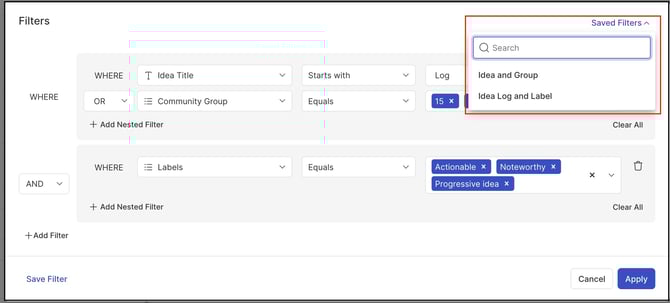
Note: Filters can be saved for later use. Saved filters can be retrieved from the top right corner.
Frequently Asked Questions
What is the difference between a system-generated report and a custom report?
Certain report actions — Rename, Clone to My Reports, Access & Permission, and Delete — are not available for system-generated reports, while custom reports created through Create Report support the full set of Actions.
Can two reports share the same name?
No. Report names must be unique; attempting to use the name of an existing report displays an error message.
Are deleted ideas or stages included in Basic Report data?
No. Any ideas or stages that have been deleted are excluded from Basic Reports.
What report types are available when creating a report?
Three report types are available: Basic Report, Historical Snapshot Report, and Journey Report.
How can a saved filter be reused?
A saved filter can be retrieved from the top right corner of the Filters in Report panel.
Related Articles